
Recently my partner and I went to see Code Unknown or Code Inconnu (2000) directed by Michael Haneke, and the film became a simulacrum of multilingualism which we return to so often in class. The original film is in French, directed by an Austrian filmmaker, and has about a third of its dialogue in Romanian, LSF (Langue de signes français), Malinka, and Arabic. Presented and distributed as a “French” film in the wavy canon of “French” cinema, I’m reminded a bit of Yildiz’s argument for Turkish as a German language.
These languages—Romanian, LSF, Malinka, Arabic—belong, then, to the conceptual atmosphere of French cinema; actually, instead of saying they belong to it, these languages are critical nodes that shape what frenchness or French cinema even is. They are their own agents and are presence-making in the sonorous quality of the film. They are not “other” languages than French included in the film. They are part and parcel of the lingual landscape of France.**
Layered over this on-screen multilingualism were the literal on screen subtitles for the English speaking viewers watching the film 26 years later in the Lower East Side of New York. For the most part, there would be one language spoken in the film at a time, or if multiple languages were happening, each character took their turn speaking and it all came out the same in the green-haloed English text that underlined each frame.
And then—there was one scene around a kitchen table where LSF and French were being uttered at the same time but only one conversation was being subtitled in English—the one happening in LSF on the right side of the frame between Amadou and his littlest sister. The other conversation, between his older sister (at the table) and his mother (furthest back) switches between French and Malinka, and remains untranslated in the subtitles. If you do not know these languages, you miss half of the dialogue in the scene, which, while it stays separate from Amadou and his sister’s conversation, the two conversations enmeshment builds an important tension.
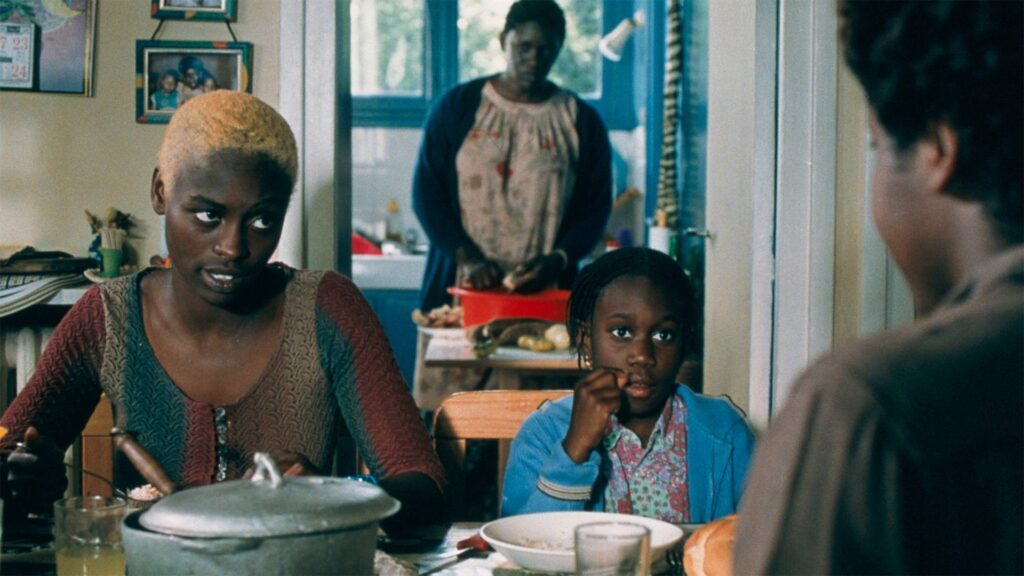
This is the first fissure we see in terms of form and translation—my partner and I wondered if we had seen the film in French if the LSF conversation would have still been prioritized or would there have been space on the screen for the interjections of the Malinka in between since the French wouldn’t have to also be translated. The extra layer of English meant that, for this 2000s film, there was not enough room in the frame to encompass all three (French, Malinka, LSF) if they were happening simultaneously. Amadou is also responding both in LSF and in spoken French to his little sister. How to distinguish which French is coming from who? And would we have had enough time to read it all? What does this change to the viewing if we are mostly reading over a scene?
While I missed the interjections in Malinka, the untranslated French in the scene added a sonorous quality to the experience of viewing. I got the gist from the older sisters retorts to the mother, but I could sense the room become a bit more uncomfortable. We were in a new moment that not everyone—including me—could totally understand. But again, is this just another moment where the illusion of understanding is unraveled?
To be watching this in New York meant that there were certainly people who understood languages I did not in the film sitting in the room with me. But it also meant that the availability and aesthetic desire to watch “French” cinema allowed this film to be shown 45 minutes from my house, instead of a plane ride away. I didn’t grow up with this access. In a rural state like Maine, accessing “French” film meant catching something in Boston or putting a DVD in our special player that could read discs from both countries, discs my dad would have brought back from France or Switzerland. I know we can stream now, but there is a nagging marvel I still carry that to see a film in theaters in a different language(s), a proximity to urbanity feels like almost a prerequisite in the United States. And in order for me to have these very questions about which conversation was translated into English and why, the film had to be shown here, not in the hexagonal there.
New questions emerge depending on where we are at the moment of viewing—this is clear. Which takes me to the second fissure. The film opens and closes with children who sign LSF playing charades with one another. Amadou’s sister is in this group. The first time around, the signs are translated into English as subtitles, but the film closes with this child’s signed utterance left untranslated. This is a sieve by way of lingual code, an instant that dislodges the expectation of translation and resets the viewer who does not know LSF into an unknown space. We can try to decipher, interpret gesture and expression, but the intonations are in the body. The game of charades—of guessing language through play—is turned on us. We are asked to look, not at subtitles, but at the child’s body. What is being said? What does it mean to know?
**[[ I have trouble incorporating these languages, however, into an argument along the lines of saying that Arabic, too, exists as a French language, not because Arabic shouldn’t be considered as part of the French sonority, but because this proposition rests on the question of citizenship, of a imperially “othered” language now belonging-to the mother state of France. It feels like, to me, there is a danger in the imperial state subsuming these languages and somehow, along the way to being “French,” neutralizing their historical and sociopolitical power. ]]


Thank you, Claire, for putting your finger on an issue that, as James will attest, kept coming up in a class on Spanish-language writing in the US last year. The proposition that there is a Spanish-language literature of the US, just as there’s a French-language literature of Canada, was unobjectionable. When discussion turned to a single writer, even if it’s someone who’s spent decades here and writes extensively about the US, people in the class were very uneasy about classifying anyone working in Spanish as part of “US literature.” (Though if a writer of any background switched to English entirely, the problem was not thorny.) Your final citation — from Haneke? — makes it clear why: “because this proposition rests on the question of citizenship, of an imperially “othered” language now belonging-to the mother state of France.”
As for multilingual subtitling — also thorny! Catherine and I were thinking about it at Satyajit Ray’s “Days and Nights in the Forest”; as non-Hindi, non-Bangla speakers, it might not have been clear, if not for one of the main characters saying to another “you have to speak Bangla with them,” that the protagonists were actually switching languages when speaking with local working people.
There are all kinds of perfectly feasible solutions for multilingual films (different colors for different languages, as your mention of “green-haloed” English suggests?). But subtitling, in the age of AI, only gets worse and worse. Also filmmakers can deliberately choose to preserve the opacity of a language they know most viewers probably won’t comprehend, as with the final few minutes in the clip you’ve posted. Certainly fits with the film’s title.